Chef 210
6 of 22- Steel
- 26C3 mono
- Edge
- 63.5 HRC
- Grind
- Full flat
- Behind edge
- 0.20 mm
- Weight
- 178 g
- Handle
- Bog oak, brass pin
The workhorse. Tall enough to knuckle-clear, thin enough to fall through an onion.
€ 360
A two-person forge · Trondheim, Norway
We make kitchen knives twice a year, in batches small enough that every blade gets both of us. Batch 27 opens for claiming on 12 October. The waitlist gets first strike.
01 · The autumn batch
Twenty-two blades, six lines, two steels and one damascus. Each knife is forged, ground, tempered and handled here — no blanks, no contract grinding. Weights are the finished knife, to the gram.
The workhorse. Tall enough to knuckle-clear, thin enough to fall through an onion.
€ 360
Same geometry as the plain chef. The pattern is the fold, not a print — see below.
€ 560
Long, narrow, a little springy. Sunday roasts, gravlax, brisket if you must.
€ 395
For small kitchens and people who chop more than they rock.
€ 330
The knife that ends up doing half the cooking. Shallots, trimming, board work.
€ 240
In-hand work. Two in the batch because we only had two blocks of oak left worth it.
€ 190
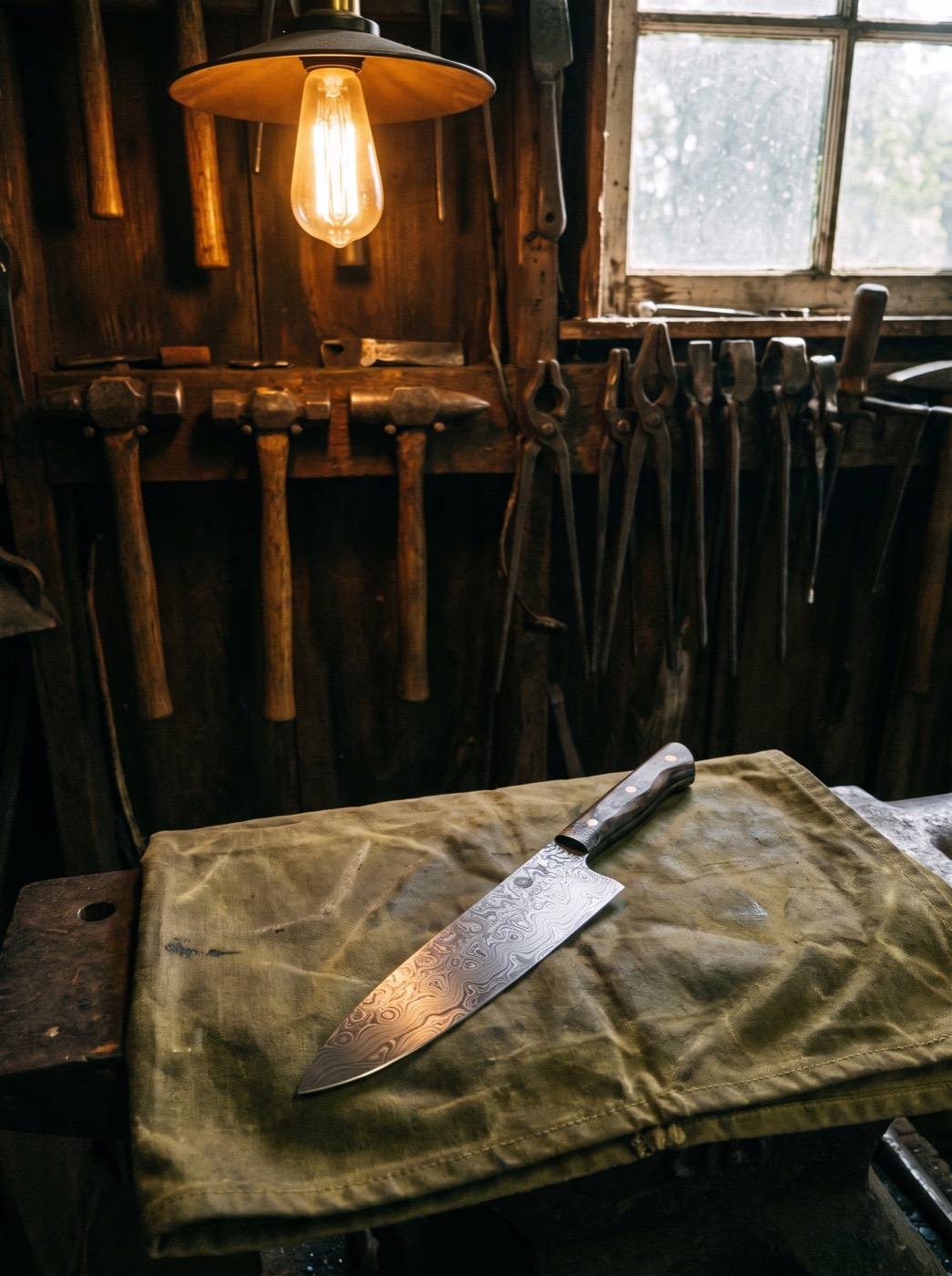
Blade 27-09
This is the fourth damascus chef of the batch: 1084 and 15N20 folded seven times over a 26C3 core, etched in ferric chloride, handle in walnut from a felled tree on Ingrid's uncle's farm. Photographed the morning it came off the strop, on the bench where it was made.
Every blade in the batch carries a number like this one — batch, then position. It's stamped under the handle scale where you'll never see it. We'll know it anyway.
FORGED — M. BERGE · GROUND — I. HALVARD
02 · The tempering bench
Hardness is easy — a file-hard blade holds a vicious edge and snaps in a drawer. Tempering trades a little hardness back for toughness, and clean steel tells you where you are: the oxide skin changes colour with temperature. Drag the bar.
DRAG THE BAR — OR USE ARROW KEYS
We temper every kitchen blade twice at 200 °C, two hours each — pale straw, both times. Past 250 °C the edge gets forgiving and soft; past 300 °C you've made a nice spring and a poor knife. Spring steel, incidentally, is where the blue range earns its living.
03 · Damascus, honestly
We stack bright 15N20 against dark 1084, weld the billet in the fire, draw it out, cut it, and fold it back on itself. Every fold doubles the count. The pattern isn't printed or etched on — it's the geometry of the fold, made visible in acid.
04 · Care
Carbon steel asks four things of you. In exchange it takes an edge stainless never will, and it goes grey-blue with your cooking — a patina, not a flaw.
Acid sits, steel marks. A pass with a dry cloth between tasks is the whole discipline.
Hot water, a drop of soap, dry immediately. The dishwasher voids nothing — we'll still fix it — but we will know.
Twenty passes on loaded leather keeps the edge off the stones for months. A strop ships with every knife.
Going away for a week? One drop of camellia oil, spread with a thumb. That's it.
If an edge chips or wanders, send it back. We regrind for the life of the blade — postage on us, turnaround a fortnight, no small print.
05 · The waitlist
The waitlist isn't a hype queue — it's how a two-person forge sells forty-four knives a year without a warehouse. When claiming opens on 12 October, the list gets the batch 48 hours before anyone else, in strict order.
No deposit. No obligation. If nothing in the batch suits you, your place carries to spring.